











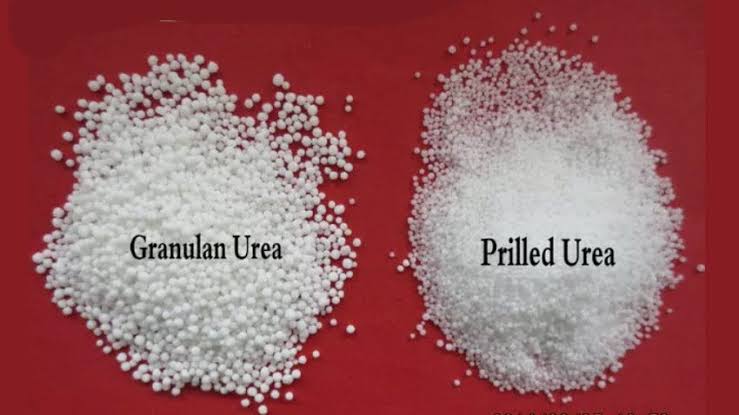
Choosing between prilled and granular urea is not simply a matter of comparing price per ton. For farmers, fertilizer importers, distributors, and industrial buyers, particle form can influence handling, storage, mechanical spreading, blending, dissolution, packaging, and the suitability of the product for a specific end use.
Both products are forms of Urea fertilizer and can have essentially the same nutrient concentration. QAFCO currently specifies a minimum nitrogen content of 46% for both its prilled and granular fertilizer products, with the clearest difference appearing in particle size.
Its published specification places at least 90% of Prilled urea in the 1-2.8 mm range and at least 90% of Granular Urea in the 2-4 mm range.
That difference matters commercially. Larger, more uniform particles can be advantageous for wide mechanical spreading and intensive handling, while smaller prills may be convenient where rapid dissolution, manual application, or established local demand favors that form.
There is also a separate category to consider: Technical grade urea. Industrial buyers may require tighter controls on impurities, additives, particle form, or other properties that are not defined by the simple label ‘46% urea.’
Prilled Urea vs Granular Urea at a Glance
|
Factor |
Granular Urea |
Prilled Urea |
|
Typical particle form |
Larger granules |
Smaller spherical prills |
|
QAFCO example size range |
۲-۴ mm, 90% minimum |
۱-۲.۸ mm, 90% minimum |
|
Nitrogen content |
۴۶% minimum |
۴۶% minimum |
|
Mechanical spreading |
Often favored for wider, more uniform broadcast patterns |
Suitable, especially where wide throw distance is less important |
|
Handling |
Well-made granules can offer strong physical durability |
Good quality depends on prill strength and handling |
|
Dissolution |
Larger particles generally take longer under similar conditions |
Smaller particles generally dissolve faster |
|
Common buying decision |
Mechanized farming, blending, robust handling |
Manual use, dissolution, local market preference, selected technical uses |
The particle-size figures above are producer-specific examples, not universal limits for every origin. Buyers should always compare the actual supplier specification rather than assuming all prilled or granular urea has identical physical properties.
What Is Prilled Urea?
Prilled urea is produced by forming molten or concentrated urea into small, generally spherical particles through a prilling process. It is widely traded in agricultural markets and is also supplied for selected technical and industrial applications. Yara, for example, offers technical urea prills for industrial uses and animal feed, with or without anti-caking treatment.
The smaller particle size can be useful where the material will be dissolved or applied manually. However, buyers should not assume that every prilled product has the same physical quality. Particle uniformity, moisture, fines, strength, storage history, and anti-caking treatment can all affect handling.
What Is Granular Urea?
Granular urea is produced through a granulation process that creates larger particles. Chemically, fertilizer-grade granular urea is not automatically stronger than prilled urea. QAFCO publishes the same minimum nitrogen level, maximum biuret, and maximum moisture values for both forms; the major published distinction is particle size.
The commercial advantage of granulation is therefore mainly physical. Uniform fertilizer particles can improve flow and field distribution, and Yara notes more generally that fertilizer density, shape, size, strength, and free-flowing characteristics influence spreading performance, segregation, dust formation, and caking.
Which Is Better for Mechanical Spreading?
Granular urea is often the stronger choice for large-scale mechanical broadcasting because larger and more uniform particles tend to behave more predictably in spreading equipment. This can be important for commercial grain farms, plantations, and contractors using wide working widths.
The word ‘granular’ alone, however, is not a quality guarantee. A shipment containing excessive fines or weak, broken particles may spread less consistently than a well-manufactured prilled product. Buyers serving mechanized agriculture should therefore request particle-size distribution and, where relevant, physical-quality data rather than relying only on the product name.
Which Is Better for Manual Application or Dissolution?
For manual broadcasting, both forms can work well. In markets where fertilizer is commonly applied by hand, the wider mechanical throw associated with larger granules may provide little practical advantage. The decision may depend more on delivered price, farmer preference, bag size, local availability, and product quality.
For dissolution, smaller particles generally have more surface area relative to their mass, so prilled urea can dissolve faster under otherwise similar conditions. This does not mean prilled urea provides more nitrogen or automatically produces better crop performance.
Once equivalent fertilizer-grade products dissolve, their urea chemistry is essentially the same; agronomic performance also depends on soil moisture, application timing, incorporation, irrigation, temperature, and nitrogen-loss management.
Granular Urea and Fertilizer Blending
Granular urea can be attractive in dry blends when the other fertilizer components have compatible particle sizes and densities. Large differences between components can encourage segregation during transport, storage, and spreading.
For this reason, buyers should compare actual particle distribution, bulk density, and blend compatibility rather than assuming every granular urea will perform well in every NPK blend.
Storage, Fines and Caking
Both forms must be protected from moisture. Urea is hygroscopic, and poor storage can lead to caking, lumps, reduced flowability, damaged bags, and handling problems. Covered storage, good bag condition, controlled humidity, careful stacking, and reduced unnecessary handling are important regardless of particle form.
Physical strength also matters. Durable particles are less likely to break during conveyors, ship loading, bagging, warehouse stacking, and field handling. A high-quality granule may generate fewer fines than a weak product, but granulation itself does not guarantee low dust. A well-made prill can be commercially preferable to a poorly made granule.
Agricultural Grade vs Technical Grade Urea
This distinction is especially important for industrial buyers. Technical urea may be purchased for resins, wood products, water treatment, animal feed, or other industrial processes, and the required specification may include tighter controls on impurities, additives, biuret, moisture, or particle form. Yara supplies technical urea prills and also lists technical-grade granules for industrial customers.
An industrial buyer should therefore specify the intended application rather than ordering only ‘46% granular urea.’ The same principle works in reverse: an agricultural buyer may gain little from paying for a specialized technical specification that the farming application does not require.
How Should International Buyers Compare Offers?
Price should be compared only after the technical and commercial basis is aligned. Confirm whether both suppliers are quoting the same form, nitrogen guarantee, biuret and moisture limits, particle-size distribution, fines level, and anti-caking treatment, and origin, packaging, and inspection terms. FOB, CFR, and CIF quotations should also be normalized before deciding which supplier is actually cheaper.
For significant purchases, request a recent Certificate of Analysis that identifies the product form and reports the relevant chemical and physical parameters. If particle quality is one of the reasons you are paying a premium for granular material, third-party inspection should not be limited to nitrogen content alone.
Buyer Checklist before Placing an Order
|
Question |
Why It Matters? |
|
Is the product granular, prilled, or technical grade? |
Confirms the correct product category |
|
What are nitrogen, biuret, and moisture limits? |
Verifies chemical specification |
|
What is the particle-size distribution? |
Defines the main physical difference |
|
What fines or anti-caking limits apply? |
Affects handling and storage |
|
What is the origin and packaging? |
Influences logistics and market acceptance |
|
Can the supplier provide a recent COA? |
Supports technical verification |
|
Is third-party inspection available? |
Can reduce quality and quantity risk |
|
Which Incoterm and loading schedule apply? |
Makes quotations commercially comparable |
Final Verdict
Neither form is universally better. If your priority is wide mechanical spreading, particle uniformity, strong handling characteristics, or compatibility with similarly sized fertilizer granules, granular urea is usually the more practical candidate.
If your market favors smaller particles, manual application, faster dissolution, or a specific technical prill, prilled urea may be the better fit.
The most important point is not to confuse particle size with fertilizer strength. Commercial fertilizer-grade prilled and granular urea can carry the same 46% minimum nitrogen specification. The purchasing decision should be based on application, physical quality, storage and handling conditions, local market preference, and total delivered cost.
For industrial applications, define Technical grade urea requirements separately and confirm that the supplier’s impurity profile, additives, particle form, and documentation match the downstream process. Buy for the application, not for the label.
.

بدون دیدگاه